
The semiconductor equipment market is expected to reach US $108.5 billion in 2022, setting a new record of 5.9% growth

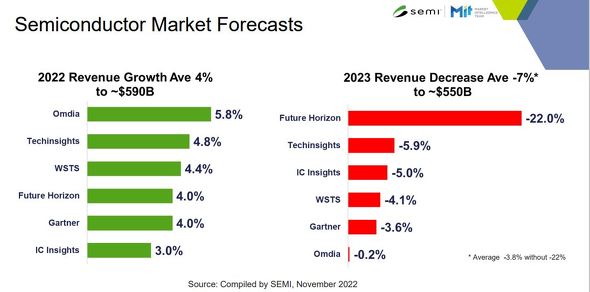
the semiconductor equipment market will reach US $108.5 billion, a new record of 5.9% growth, surpassing the historical high of US $102.5 billion in 2021. By 2023, the sales of semiconductor manufacturing equipment is expected to be reduced to US $91.2 billion in front-end and back-end processes, but will recover in 2024." Regarding the semiconductor market, "In 2022, the average growth rate of each research company will be 4%. In 2023, it is expected to shrink by an average of 7%, but Future Horizo n is expected to shrink by 22%. We expect a significant decline." He said.
By region, Chinese Mainland, Taiwan, China and South Korea are expected to remain the top three countries for capital investment in 2022. In 2023, Chinese Mainland will remain the first, but in 2024, Taiwan, China is expected to win the championship. Investment in all regions except South Korea is expected to increase in 2022, but it is expected that most regions will decline in 2023, and then recover in 2024.

From the perspective of industry sales, the wafer plant equipment industry will grow by 8.3% year-on-year in 2022, reaching a historical high of 94.8 billion US dollars. It is estimated that by 2023, it will decline by 16.8% to US $78.8 billion, but by 2024, it will rise by 17.2% to US $92.4 billion.
The OEM and logic parts account for more than half of the equipment revenue of the wafer factory. It is estimated that the revenue will reach 53 billion dollars by 2022, with a year-on-year growth of 16%. This is mainly due to the growth of demand for cutting-edge and mature process nodes. It is estimated that the revenue will reach 53 billion dollars by 2023, with a decline of 9%.
In terms of memory and storage, due to weak commercial and consumer demand, the sales of DRAM devices are expected to decline by 10% to $14.3 billion in 2022, 25% to $10.8 billion in 2023, and the sales of NAND devices are expected to decline by 2022. It is estimated that it will decline by 4% to US $19 billion by 2020 and by 36% to US $12.2 billion by 2023.
After achieving a strong growth of 30% in 2021, the sales of semiconductor test equipment market is expected to decline by 2.6% to US $7.6 billion by 2022. The sales volume of assembly and packaging equipment will increase by 87% in 2021, but it is expected to decrease by 14.9% to $6.1 billion in 2022, and by 13.3% to $5.3 billion in 2023. Capital expenditure on back-end equipment is expected to resume in 2024, with test equipment increasing by 15.8% and assembly and packaging equipment increasing by 24.1%.
Ajit Manocha, president and CEO of SEMI, said when commenting on future market trends, "The record number of new semiconductor wafer factories (23 in 2021 and 33 in 2022) has led to the growth of sales of semiconductor manufacturing equipment by more than US $100 for the second consecutive year, an increase of US $1 billion. With the emergence of new applications in various markets, the semiconductor industry is expected to grow significantly in the next decade. The long-term prospects of the semiconductor industry are promising. "Increasing investment in semiconductor manufacturing is critical to laying the foundation for the continued growth of various emerging applications."
Passive components are not afraid of the cold winter of semiconductors, and large factories are busy expanding production against the trend
Related Article

Elena, the former foreign trade salesperson of ourforeign trade sales department, has officially resignedon June 9, 2023 due to personal reason. 0ur companysolemnly declares that any business and words and deedscarried out by Elena from now on have nothing to do withand our company does not assume anyourcompany,responsibility!

However, under the cold winter of semiconductor, there are still some signs that demand in some subdivided fields is expected to slowly recover, and manufacturers are also expanding production against the trend, such as passive components.